Husqvarna 455 Rancher

Husqvarna / Gas / Farm & Ranch

Husqvarna 455 Rancher

50cc class
55.5cc
2.6 kW rated
20 in
cuts to about 18 in
13.2 lb
powerhead only
~$589
approx., with 20" bar and chain
Check price on Amazon

We may earn a commission. Price and availability on Amazon's site may differ.

4.6/5 across 699 reviews on Lowe's. Nobody reviews saws here; that number is theirs.

America's default farm saw, full stop — the 455 Rancher has been the answer to "what chainsaw should I buy for firewood" at Lowe's for two decades, and its 4.6-star average across about 700 reviews there says the formula still works: 55.5cc, a 20-inch bar, and a chassis that shrugs off neglect. Owners love that it starts spring after spring and pulls a full 20 inches through oak without drama. The counterpoint lives on the forums, where the 455 is the perennial punching bag: at 13.2 pounds for the powerhead it's genuinely heavy for its power class, the vibration is noticeable next to a 550 XP, and the pro crowd sniffs at the consumer crankcase. Both camps are right. This is a saw built to survive ranch sheds, not win power-to-weight arguments — and the Stihl MS 271 and Echo CS-590 comparisons are the most-argued matchups in the category for a reason.

Best for: Property owners who want the proven, widely-serviced default for firewood and don't mind carrying extra weight.

Specifications

Engine class
50cc class (by displacement)
Engine
55.5 cc
Bar range
13-24 in
Single-pass cut
about 18 in (bar minus 2)
Chain
3/8" pitch / .050" gauge
Weight
13.2 lb, powerhead only
Use case
Farm & Ranch
Warranty
2-year consumer (extendable to 4 with fuel registration)
Model
455 Rancher

Manufacturer figures except the engine class and single-pass cut, which are derived here. What each spec means

  • 4.6 stars across ~700 reviews
  • The default American farm saw
  • Pulls a 20-inch bar through oak

What owners like

  • Two decades of proven reliability — the definition of a known quantity
  • 4.6-star Lowe's aggregate across roughly 700 reviews
  • Genuinely pulls its 20-inch bar in hardwood
  • Parts, bars, and chains stocked everywhere from Lowe's to rural dealers
  • Smart Start, fuel pump, and inertia chain brake as standard
  • Tolerates neglect that would kill fussier saws

Common complaints

  • The chain tensioner runs out of travel on this short frame — after a few years the screw reaches its limit and the chain goes slack mid-cut, and the fix is to break a drive link out
  • A weak bar oiler is the complaint owners repeat most about the 455/460 family; one sold his saw over it
  • 13.2 lb powerhead is heavy for 55cc — fatigue shows on long days
  • Vibration is noticeably stronger than modern pro saws
  • Forum consensus favors the CS-590 on value and the MS 271 on refinement
  • Consumer crankcase — not rebuildable pro construction
  • At $589 it has crept into striking distance of better saws

What owners say

Read from owner discussions, long-term write-ups and dated retail reviews; nothing here was measured on this site.

The 455 Rancher is the default answer to "what saw for firewood" in American farm country and the owner evidence broadly backs it, with caveats. Owners report saws nearly twenty years old still working, a predecessor that sat two seasons in a shed with fuel in it and still fired, and a Michigan owner heating his house entirely with wood on two cords a year who loves his. An owner who runs both a 455 and much larger pro saws puts the real difference at about fifteen minutes per cord, which is the most useful calibration in any of these threads: the pro saw buys you comfort and service life, not a transformed day.

The faults are consistent enough to plan around. Oiling is the big one — one owner sold his off over the oiling system, and the owner of the closely related 460 names a weak oiler on the family and suspects this saw has it too. The chain tensioner is the other: on a short-frame saw it runs out of adjustment travel, and owners with high-hour saws end up removing a drive link with a chain breaker and checking the drive and nose sprockets, which wear and stretch chains. Consumables are expensive relative to the saw — one owner's dealer wanted $170 to fit a $40 carburettor on a seven-year-old saw — and one new unit turned out to have a faulty ignition coil in its first week. Push it into genuinely big hardwood on the 20-inch bar and it bogs; an owner with 100 acres moved up to a 60cc pro saw for exactly that reason.

Its rival in every thread is the Echo CS-590 Timber Wolf, and the honest summary is that owners who buy it over the 455 do not regret it — one returned a $570 455 unopened for a CS-590 that cost $100 less, and the recurring arguments are the Echo's five-year warranty, its magnesium case and the fact that it takes a muffler mod well. Owners who stay with the 455 do so for dealer proximity, parts commonality and the fact that it is easy to work on. Inside Husqvarna the cheap upgrade owners point at is the 545 XP, which one calls only $30 to $40 more than a 455 with slightly more power in a better-built saw. Buy it if you cut a couple of cords a year and value the saw being serviceable everywhere; register Husqvarna fuel at purchase to extend the warranty, keep the chain sharp and watch the oiler.

What owners like

  • Twenty-year service lives are on the record. One owner bought his in 2007 to clear a homesite and says it has been great the whole time; another keeps five saws of the series running.
  • It tolerates being ignored. The 55 Rancher that preceded it sat two years in a shed with fuel in it and still fires right up, after ripping a walnut slab, felling trees, bucking and cutting stump roots. A 455 owner heating an 1890s farmhouse exclusively with wood in Michigan is on the same page.
  • The real-world speed penalty against a far more expensive saw is smaller than owners expect. An owner who runs both reckons the difference between cutting a cord with a 455 and with a much larger pro saw is about fifteen minutes.
  • It is comparatively light and nimble for the class, parts support is excellent and it is easy to work on — the reasoning of an owner who services his own saws and recommends it to anyone whose nearest good dealer is a Husqvarna one.
  • On promotion it gets cheap. Owners report $380 at Lowe's during a sale against roughly $570 at the regular price, which changes the value argument against an Echo considerably.

Common complaints

  • Chain oiling is the complaint owners repeat most. One sold his off specifically because he could not get over the oiling system; an owner of the closely related 460 names a weak oiler on the family and suspects the 455 shares the fault.
  • The chain tensioner runs out of travel. After years of use the screw reaches its limit and the chain goes slack mid-cut with nothing left to take up — the short frame simply does not give enough adjustment length. Owners' fix is to pull a drive link out with a chain breaker and to check the drive and nose sprockets for wear, since both are consumables that stretch chains.
  • Parts pricing and carb life sting. A saw bought new in 2018 and run only on premix would not take full throttle by 2026; the dealer quoted $170 to fit a $40 carburettor, and the owner rebuilt it himself with about $150 of parts, calling the sprocket, fuel lines, bulb, carb, plug, filter and tank vent overpriced and short-lived.
  • Out-of-box electrical failures happen. A new 455 that started fine then stalled whenever it was put to work was diagnosed by the dealer as a faulty ignition coil in its first week.
  • It bogs in big hardwood on its 20-inch bar. An owner with 100 acres of 8 to 24 inch ash, maple, birch and pine says it simply was not cutting quickly, and the standing advice is that 20 inches is its ceiling and not its comfortable working length.

Questions owners ask

Why has my chain tensioner run out of adjustment?

It is a known limit of the short-frame design, and owners with high-hour saws hit it. The chain has stretched past what the screw can take up. The usual fix is to remove a drive link with a pocket chain breaker, grinding off a rivet head, punching the link out and reconnecting with a fresh link and rivet rather than reusing the old one. Before you do, check the drive sprocket and the bar nose sprocket — both are consumables, both wear notches that destroy chains, and a worn one will stretch the next chain too. Note also that drive-link counts vary within the family, with 455 owners reporting 72 links on a 20-inch bar where a 460 owner's takes 70, so count rather than assume.

Does the 455 Rancher have AutoTune?

No. Owners correct each other on this regularly because advice meant for AutoTune and M-Tronic saws keeps getting aimed at it. The 455 has a conventional carburettor with adjustment screws, so a saw that starts and idles cleanly but dies under throttle is a fuel-delivery problem to diagnose — a blocked high-speed circuit, a restricted tank vent, or on a brand-new saw, a defective coil, which is what one owner's dealer found in week one.

Is the Echo CS-590 actually the better buy?

On value, most owners say yes, and one bought a 455 for $570, read around, returned it and picked up a CS-590 for $100 less. The arguments for the Echo are the five-year consumer warranty, a magnesium crankcase against the Husqvarna's plastic one, more displacement for the money and how well it responds to a muffler mod. The arguments for the 455 are that it is lighter and more nimble, that parts are stocked everywhere and that it is easier to work on. If your nearest competent service counter is a Husqvarna one, owners say buy the Husqvarna.

How much bar should I run on it?

Eighteen or twenty inches. Owners who fell for a living are blunt that a 24-inch bar is too much for it even though it is rated for one — one who spent two decades falling in Montana and Wyoming did it on a 24-inch bar and still says it is too long for this saw. Twenty is the best all-round combination and does not slow down in hardwood, but it sits right at the cusp; go longer and you are underpowered and the oiler is the next thing to complain.

What does it cost to keep one running?

More than the saw's price suggests. An owner who bought new in 2018, ran nothing but Husqvarna premix and cleaned it regularly was looking at a shot carburettor by 2026, with his dealer quoting $170 of labour on a $40 part; he bought roughly $150 of parts — carb, sprocket, fuel lines, primer bulb, plug, air filter, tank vent — and did it himself. Owners who do their own work find it straightforward; owners who do not should price local labour before buying, because a couple of shop visits approaches the cost of a new saw.

Drawn from 6 owner threads and long-term reviews, kept on file with this entry.

Compare the Husqvarna 455 Rancher

Nearest alternatives

More from Husqvarna
Husqvarna 450X Rancher

Husqvarna / Gas

~$550

Husqvarna 450X Rancher

50cc class
50.2cc
engine
20 in
bar
11.2 lb
bare

Landowners cutting firewood and clearing fencelines who want the strongest 50cc Rancher without stepping up to the 455.

Farm & Ranch
Husqvarna 545 Mark II

Husqvarna / Gas

~$640

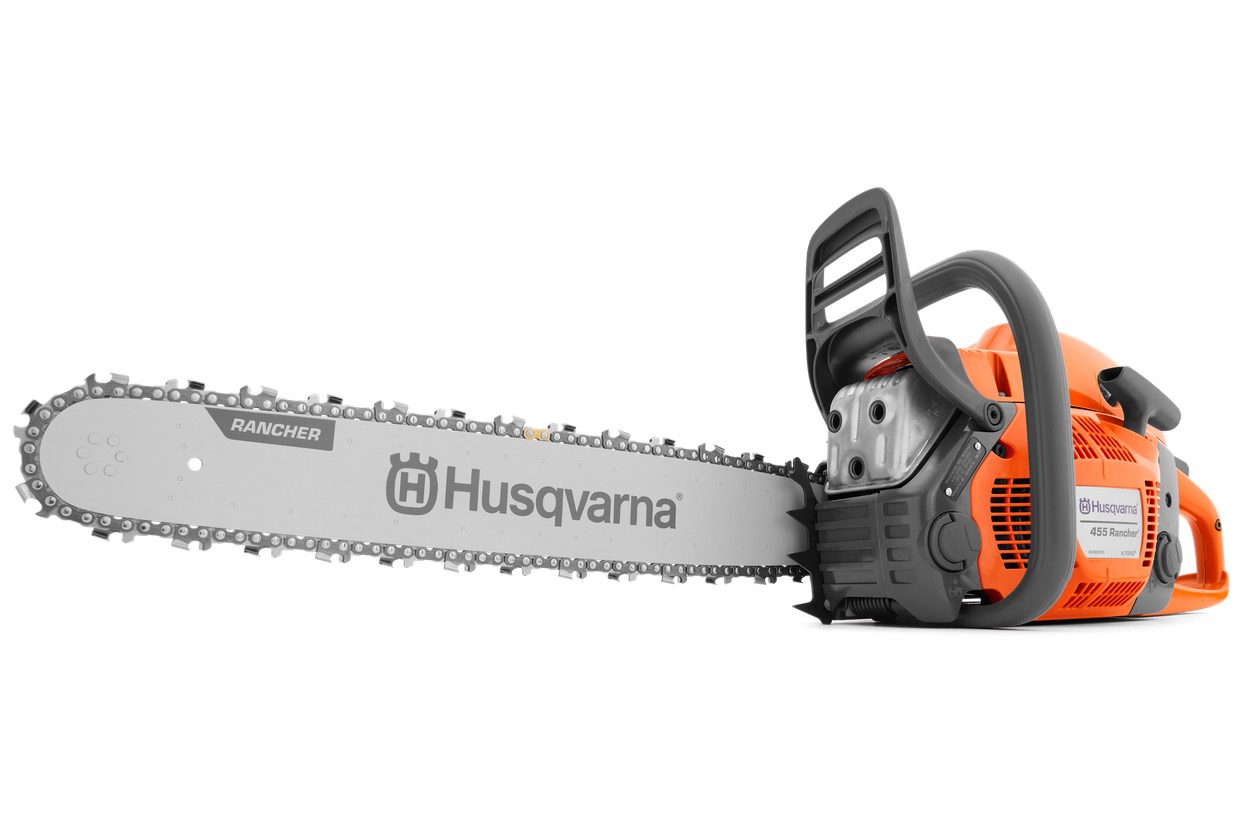
Husqvarna 545 Mark II

50cc class
50.1cc
engine
16 in
bar
11.7 lb
bare

Firewood cutters and part-time pros who want the 550 XP Mark II's chassis and AutoTune without paying for the last 0.3 kW.

Professional
Husqvarna 450S Rancher

Husqvarna / Gas

~$499

Husqvarna 450S Rancher

50cc class
50.2cc
engine
20 in
bar
11 lb
bare

Firewood cutters who want 50cc capability but prioritize the lightest swing in the Rancher line.

Farm & Ranch

Sources for this entry